Table of Contents
- Introduction: Why VR Gaming Experiences Matter
- What Is a VR Gaming Experience?
- Key Elements of Immersive VR Gameplay
- Popular VR Gaming Experiences Today & Genres
- How VR Gaming Evolves: Innovations & Trends
- Challenges & Considerations for VR Players
- Integrating Your Font Studio with VR Visuals
- Final Thoughts
- References
1. Introduction: Why VR Gaming Experiences Matter
VR Gaming Experiences is no longer a niche or futuristic concept — it is actively redefining how players experience digital worlds. A strong “VR gaming experience” combines immersion, interactivity, sensory feedback, and creative storytelling into a believable virtual environment.
For a font studio like Edric Studio, exploring VR gaming experiences is more than tech curiosity — it offers inspiration for visual branding, motion typography, environment type treatments, and showcasing your fonts in immersive contexts.
In this article, we’ll explore what makes a compelling VR gaming experience, key design elements, standout examples, emerging trends, and how your font artistry can intersect with VR visuals.
2. What Is a VR Gaming Experience?
A VR gaming experience refers to the entire user journey while playing a game in virtual reality — from setup, immersion, interactivity, to exit. It involves more than just graphics; it’s about a sense of presence — feeling like you are inside the virtual world rather than merely viewing it.
According to TechTarget, VR gaming is the application of a 3D artificial environment to computer games, presented in a way that supersedes the real environment to create suspension of disbelief.
To deliver a meaningful VR gaming experience, a system must deliver low latency tracking, convincing spatial audio, responsive controllers or haptics, and coherent world design.
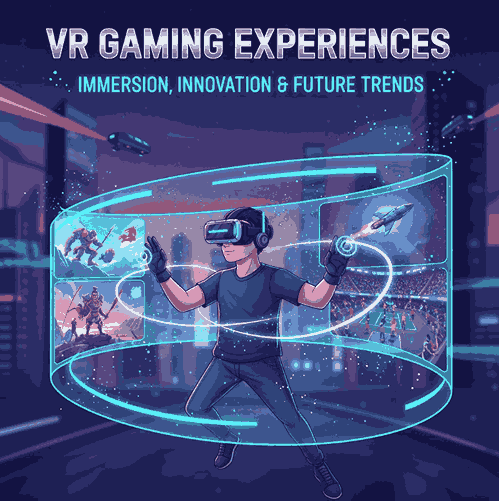
3. Key Elements of Immersive VR Gameplay
To design or evaluate a quality VR experience, these are the foundational components:
- Presence & Motion Tracking
Accurate head, hand, and body tracking is critical. Without it, the illusion breaks and the user feels detached. Studies on presence show that small mismatches in feedback or delay can significantly reduce immersion. - Low Latency / High Frame Rate
VR must operate at high refresh rates (90 Hz or more) with minimal lag to avoid motion sickness and disorientation. - Spatial Audio & Sound Design
Realistic 3D audio cues — footsteps, directionality, ambient sound — deepen the sense of being in a space. - Haptics & Physical Feedback
Controllers, haptic vests, or vibration systems help translate virtual interactions into tactile sensations. - Intuitive Interactions
Grabbing, throwing, teleporting, or physically walking (if space allows) should feel natural and responsive. - Compelling World & Narrative Design
The design of environments, lighting, scale, interactivity, and story all contribute to immersion. - Comfort & Usability
Comfort constraints (motion sickness, fatigue) must be considered in level design, movement mechanics, and session length.
These aspects combined determine whether a VR game is simply a novelty or a powerful, lasting experience.
4. Popular VR Gaming Experiences Today & Genres
Here are some of the standout VR experiences and genres that illustrate the possibilities:
- Action & Adventure / Story-Driven
Games like Half-Life: Alyx or Wraith: The Oblivion – Afterlife push narrative immersion in VR spaces. - Rhythm & Dance
Just Dance VR (2024) brings dance mechanics to 3D space, pairing motion with musical cues. - Simulation / Racing / Flight
Racing in VR offers heightened realism — physical turns, spatial judgment, immersive cockpit design. - Sports & Tabletop
Eleven Table Tennis is a VR version of the classic sport with tactile paddle control. - Arena / Shooter / Action
Fast-paced action where spatial awareness and physical movement are key. - Escape Rooms / Immersive Installations
Experiences like Hyper Reality combine VR environments with physical props and set pieces. - Sandbox / Creation Worlds
Players can build, explore, experiment — e.g. VR creative tooling or open worlds.
Each genre emphasizes different elements: storytelling, reflexes, exploration, interaction, or social elements.
5. How VR Gaming Evolves: Innovations & Trends
VR continues evolving rapidly. Some key trends to watch:
- Wireless, Lightweight Headsets
More comfortable, untethered devices with high fidelity graphics are pushing adoption. - Mixed Reality & Pass-Through
Integrating real-world elements with virtual overlays to blend digital & physical. - Social VR Worlds
Platforms where players interact as avatars in shared spaces, attend events, or co-create experiences. - Haptic & Sensory Feedback
Beyond vibrations — suits, glove feedback, environmental effects (wind, heat, etc.). - AI-Driven Environments & Dynamic Narratives
Worlds that adapt to player behavior or generate content procedurally. - Typography & Motion Design in VR
Text elements and animated fonts are becoming spatial design tools in VR menus, interfaces, signage. - Shorter Session Design
Meta’s research suggests ideal VR session durations of 20–40 minutes, balancing immersion and comfort.
As hardware, software, and user expectations evolve, VR becomes more available and creatively expressive.

6. Challenges & Considerations for VR Gaming Experiences Players
While powerful, VR experiences face several obstacles:
- Cost & Accessibility
High-end hardware is still expensive; not everyone can access premium setups. - Motion Sickness / Discomfort
VR sickness arises from mismatches in motion or visual cues; careful design is required. - Physical Space Constraints
Many users have limited room to move — design must adapt for seated or room-scale play. - Design Limitations
Text legibility, UI layout, scale, and accessibility (for disabled or motion-limited users) remain challenging. - Content Fatigue & Novelty Decay
As VR becomes more common, novelty fades — sustained engagement must come from quality content. - Standardization & Interoperability
Fragmented hardware, platform walled gardens, content compatibility issues hinder broad adoption.
Understanding these helps creators, brands, and designers craft better experiences or anticipate user pain points.
7. Integrating Your Font Studio with VR Gaming Experiences
As a font studio, there is a creative bridge you can build:
- VR Typography
Place your fonts in 3D space — signage, labels, interactive 3D text elements. - Font + Environment Mockups
Use AI-rendered or VR backgrounds as mockups to show how your fonts look in dynamic scenes. For example: - Type Animations & Motion
Animate your fonts within VR UI designs or title sequences. - Brand Atmospheres
Use VR visuals as moods, backgrounds or launch experiences on your site to showcase your fonts in immersive settings. - Presentation & Demos
Create interactive font previews in VR or AR environments for clients or audiences.
By situating your fonts in 3D and virtual worlds, you expand their expressive power beyond flat media.
8. Final Thoughts
VR gaming experiences are redefining what immersive digital storytelling and interaction can be. For creators, especially those in design and type, VR offers a dynamic arena to explore new typographic frontiers.
By understanding the core elements of immersion, leveraging emerging trends, and embedding your font work into virtual worlds, Edric Studio can position its typeface catalog not just as static assets — but as integral components of tomorrow’s interactive media.
If you like, I can help you design a VR-style font display page (immersive previews) for your site or create short excerpts / social post versions of this article. Want me to do that next?
References
- TechTarget — What is Virtual Reality Gaming?
- G2 article — How Virtual Reality Is Revolutionizing Gaming
- ScienceDirect — Virtual reality technology and game enjoyment
- Jabil — The future of AR & VR gaming adoption